
Is DENT Wireless’ current referral marketing strategy still effective? What are the negative effects caused by referral marketing and how to overcome them?
Table of Contents
- 1 DentWireless’ Current Marketing Strategy (for data and prepaid top-ups)
- 2 The Positive and Negative Effect of the Referral Marketing Strategy
- 3 Active user base vs total user base
- 4 The effects of the current marketing strategy on the DENT token price
- 5 Negative effects of the Offer Wall rewards?
- 6 Negative effects of the Afterburner Loyalty Program?
- 7 Recommendations and tips to change the current Marketing Strategy
- 8 Referral marketing system and bonus types
- 9 Referral Marketing vs Affiliate Marketing
- 10 Recommendations with respect to inflated data packages prices
- 11 Recommendations with respect to extra DENT tokens coming into circulation
- 12 Sub Conclusion and Summary
- 13 Marketing with respect to the eSIM launch
- 14 Should DW continue with referral marketing or switch from marketing strategy, or at least add some other marketing “tactics” as well?
- 15 What about other marketing tactics?
- 16 What’s the difference between marketing and selling?
- 17 Some examples of the marketing campaigns focused on getting new users onboard other than referral campaigns…
DentWireless’ Current Marketing Strategy (for data and prepaid top-ups)
The marketing team uses “Referral” (word of mouth) marketing as the main marketing method.
“Referral marketing is the method of promoting products or services to new customers through referrals”.
I don’t think I have to explain this concept as all of you have seen it in practice… but in short…
The referral amounts of Dent are set per country and are adjusted over time based upon marketing tactics. But always both the referrer and the new user get free DENT as a reward. This is how it works… By increasing the number of free DENT for a specific country at a specific time period, the marketing team tries to stimulate users to invite friends (or the opposite by decreasing or stopping the incentives amount, to calm them down).
This way of getting new users onboard was very effective. The team learned a lot about how to implement referral marketing fast and extremely successful by just starting the campaign with some ads, where after the viral effect will take over and can run by itself as you can see in this tweet…
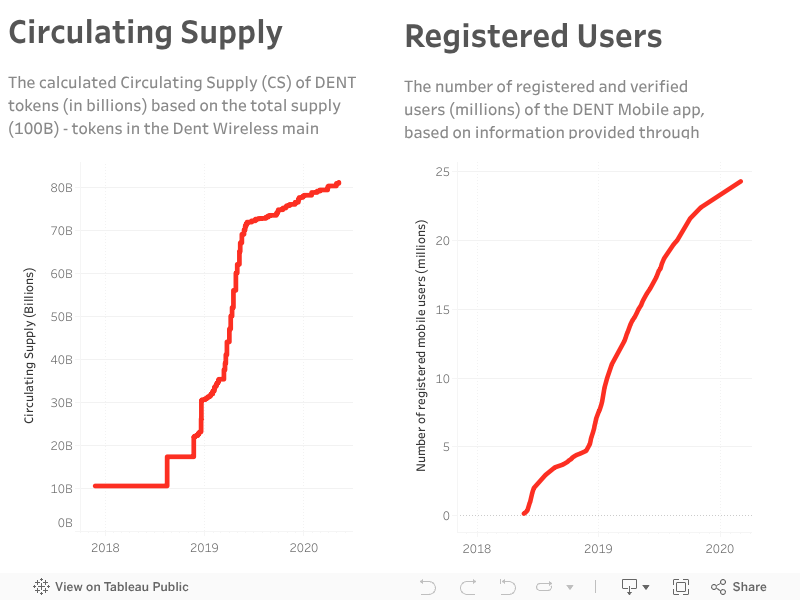
Especially in the period January-May 2019 (after the release op the new DENT Apps and opening of DENT Exchange to get a quick start), the marketing team rewarded referrers and new users with the highest number of free DENT (while increasing the user base with 10+ million new users).
Thereafter, when the circulation supply hit 70 billion DENT (May 2019), the marketing team could give away less free Dent for referrals (as the funding should now come primarily from business income – and not just from the “war chest”, i.e. the main company wallet with tokens not yet into circulation).
So, from that moment, besides a “small” amount taken out of the “war chest” each month, “earned” DENT should be used to give away as referral bonuses. (Note: the income comes mainly from selling new data/voice packages and from advertising, i.e. Offer Wall income).
So, the number of new users is still increasing each month but at a slower rate.
Below the graphs of the growth in users over time and the growth in circulating supply…
The Positive and Negative Effect of the Referral Marketing Strategy
Besides some social media marketing activities, the marketing team didn’t spend much money (or DENT) on other marketing activities. So, the team has been rather successful with this referral marketing strategy as there are about 25 million verified and registered DENT App users.
But at the moment, the referral marketing isn’t that effective anymore (see the flattening curve)…
During the last 16 months, (for my country) I have seen DENT referral amounts from zero up to 6,000 per referral. And that’s the same for all countries. There is no consistency. Influencers or users who want to invite a friend, do see different referral bonus amounts over time, resulting in complaining about not getting them or getting “too low amounts”.
I know the marketing team wants to stimulate referring during some specific marketing campaigns. And especially if a new country is added to the product matrix, I can understand the temporarily higher referral bonus amounts.
But here is the thing, the DENT price token price is currently so low that even 2000 DENT as a referral reward is worth only $0.40. Let alone, if you’ll get just 100 DENT as referral bonus (the current bonus for my country), that’s peanuts and no stimulation to invite friends (for me it’s just ridiculous).
Also, giving away free DENT (to new users and referrers) has some negative effects as well.
Freebie seekers and non-paying users
First, new users get DENT for free. And in the early days, they don’t have to spend “real” money to buy a data/voice package as they got sufficient (free) DENT. And in case they don’t have enough DENT, most users won’t use them at all, or try to get additional free DENT by referring other users and/or getting Offer Wall rewards. Only a very small portion of users actually buys extra DENT to get the wanted package(s). Hence, over 95% of DENT App users are inactive users or “freebie seekers” who haven’t and will never spend any real money. Especially, if you take into account the…
High “inflated” Data/Voice package pricing
Secondly, as side effect by getting DENT for free, users “don’t care” about the price they pay for a data/voice package as long as they can pay the packages with free obtained DENT.
This effect is self supporting as DENT App users can only spend their DENT inside the App (by either buying data/voice, or depositing in the AB Vault), and they can’t withdraw them or use them in other ways.
Plus, at the moment, data/voice trading is dominated by (a small group of) traders who instantly buy packages from DENT Wireless the moment new packages are released (at the cheapest price possible). And as traders want to make an income, they sell these packages for higher (often non-commercial) prices.
This process is even “accelerating” the moment the number of available packages is decreasing (less supply equals higher prices). Or in case a “whale” trader buys up all the available packages and can set his price as high as he wants (as there are no competitors left who can offer the package for cheaper prices).
I do understand that “it’s a free market” dictated by supply/demand… but as long as the supply is limited and (new) users can get free DENT as referral/rewards bonuses… users will accept higher prices as they got the DENT for “free”. So, there is no downward price pressure on the DENT price that users have to pay for tradeable data/voice packages.
But think about this unwanted negative aspect… as a new user you’ll pay more for packages traded on DENT Exchange in comparison with purchasing from your own telco. Do you think these users will come back (after the first free buying) and use real fiat or crypto for additional packages and want to overpay?
Of course not…
Active user base vs total user base
DENT Wireless has a user base of 25 million users, but only a very small portion is actually using the app (or DENT Exchange). The active users base consist out of:
- A small group of influencers who refer “friends” and get free referral Dents.
- A small group of packages traders on DENT Exchange.
- A small group who claim rewards by daily watching video ads (or other Offer Wall activities).
- A small group of users who did deposit DENT into the AB Vault to get free voice minutes (or other benefits as extra rewards or lower trading fees).
- A “test” group of eSIM testers of users who got the 1 GB free worldwide (or Spanish, Australian data plan) joiner bonus.
- A small group of users who buy the few data/voice packages that have competitive prices.
And that’s it…
My educated guess about the actual number of “active” users?
Less than 1% is active, so we are talking about 250,000 users at the highest.
How do I know this?
Well, just look at the daily “purchase” volume on DENT Exchange in the DENT/BTC pair. As most of the transactions are visible in this pair. (The moment an App user buys DENT with fiat directly from inside the App from DENT Wireless, or a referral/reward DENT is given, then DENT Wireless buys the necessary DENT on DENT Exchange)
Last week, the daily average volume was about 20 million DENT per day. But in better times it was 100+ million DENT.
But even at 250 million DENT a day, and you’ll divide that by 5,000 DENT (as I use for the average package value – in reality it’s higher), then you’ll end up with a maximum of 50,000 potential users.
So, my 1% estimation is probably at least 5x too high, but you got the idea now.
The effects of the current marketing strategy on the DENT token price
Well, as described above… the current referral marketing (and free rewards) strategy leads to inflated data packages prices, so you can speak about “inflation” of the DENT token. Or to say it in other words… you can buy less mobile data with your DENT as the package prices in DENT are increasing all the time (at least above the local currency prices you would otherwise pay to your local carrier).
So, less purchase power. Hence, the DENT token decreases in value.
But the current marketing strategy also leads to lower transaction volume than could be achieved if prices were more competitive. Because…
Why should you come back and buy extra packages if prices are too high?
Also, as another negative side effect, regular users won’t promote (invite friends) as they don’t see the benefits themselves.
Only a small group of “influencers” who take the time to “exploit” this model will stay active, often resulting in “fake” or new “freebie seekers” who won’t spend any money in the future.
So, a waste of time and energy resulting in “negative reviews”, lower adoption and lower DENT token price.
Negative effects of the Offer Wall rewards?
Although DENT Wireless gets a net income from these advertisers (income exceeds the given free DENT rewards), again users get free DENT with the same negative effects. Hence, you can ask this question…
Should DENT Wireless continue with the Offer Wall taken into account the negative effect of the inflated prices?
Besides the surveys and other Offer Wall tasks, especially the daily video rewards are popular among the DENT App users.
You know, those users who spend daily 30 seconds to watch a video ad and get 100-200-400 DENTs in a 3 days circle.
I really like this concept as users can earn free DENTs to lower their purchase price (or to deposit the DENT incentives into the AB Vault), and DENT Wireless gets advertising income. A win-win situation.
It’s also a unique feature that distinguishes DENT Wireless from other telco providers who don’t have this feature.
Also, the Offer Wall can “easily” be expanded with all kinds of other offers where DENT App users can earn free DENT by performing tasks. Think about partnerships with third parties (multinationals) who give away DENTs as a bonus if you’ll try out (i.e. buy) their products. You know, campaigns as “buy 12 pieces of toilet paper and get 1000 DENT for free”.
So, the problem is not the Offer Wall itself (as DENT Wireless get paid by advertisers, and users like it), but the fact that DENT App users can only use the DENT incentives inside the DENT App. And that DENT Wireless “allows” the prices of mobile data packages and prepaid top-ups to go up.
And that can be avoided with sufficient supply such that prices can be kept at the desired level.
This brings me to the…
Negative effects of the Afterburner Loyalty Program?
Actually, I really like this program as it’s a great way to reward loyal users (and/or investors). And it’s a great way to increase the purchase power and lower the token velocity, hence could potentially lead to higher DENT token price.
But for me it makes no sense to allow “freebie seekers” to get these benefits “for life” while they would never spend any real money, and DENT Wireless is making costs every month.
My “complaints” as described above are primarily related to the “tradeable” data and prepaid top-ups. For these products, the current referral marketing model is not optimal.
Recommendations and tips to change the current Marketing Strategy
What we (as token holders) want is:
Satisfied users who become customers and pay for the products, are repeatedly buying products, are true fans of the products and services, and promote the DENT Apps (and DENT Exchange) to their peers. Therefore we need…
- Sufficient supply and competitive prices.
- A better referral marketing system.
So, what would I advise the marketing team to change?
Let’s start with the…
Referral marketing system and bonus types
In my opinion, new users should always get a “deal” as first-time user, and referrers should always get a decent referral bonus. In that case, referrers can “give away” the deal, which makes it easier to “convince” friends.
The marketing team can come up with all kinds of deals, but I prefer a deal where a new user at least has to pay (a small) amount of dollars (or any local currency).
So, think about deals as:
- Pay 1, Get 2. (f.e. for eSIM: get 2GB and pay for 1GB, or get 3GB and pay for 1GB).
- Coupon Code of X% discount, only usable for first-time purchase.
- Combo deals. (f.e. get Free voice minutes if you’ll buy mobile data).
- Future discount coupons. If you’ll buy now, you’ll get a discount of X% on any future purchase.
- Cashbacks or better “DENTbacks”. If you’ll buy now, you’ll get a certain amount of DENT (to be spent on next purchases).
So, what about a decent referral bonus for the referrer?
Well, that depends on what kind of user you do refer. A freebie seeker who never spends any money is “worthless”, while a new user that spends every month $10 is worth at least that $10 as referral bonus.
So, instead of just giving free DENT as referral bonus for any new user, maybe we should consider to only give bonuses for new customers who actual pay for products.
But what kind of bonus?
There are several options to reward referrers:
- Give DENT as bonus.
- Give free products as bonus.
- Give Discounts or Coupons.
- Give USD (or local currency) as bonus.
I prefer options 1-3 for referral marketing, and I would only consider option 4 in case DENT Wireless wants to setup an affiliate marketing system where affiliates get paid in dollars based upon actual sales (a percentage of sales value).
Again be creative, but one option is that the referrer gets the same benefits as the new user. So, for example the same coupon code, or a free product. Hence, if a referrer refers a new user who buys 1GB (and gets 2GB), the referrer also gets 1 GB for free.
But I’m sure the marketing team can come up with lots of options.
Referral Marketing vs Affiliate Marketing
I see referral marketing as the little brother of affiliate marketing. While referral marketing is a way of rewarding referrers who act on a small scale, affiliate marketing comes in place as the referrer refers a large(r) number of new users/clients and does it as a means of income.
As it’s kind of a business, the affiliate marketer makes costs to build a tribe of followers. Think about content marketing (writing blog posts, publishing videos, a review or comparison website), social media marketing, email marketing, and/or advertising. All with the purpose to attract prospects (traffic) and leads them to the DENT products and gets rewarded for either the lead or the sale.
Of course, due to the higher numbers, an affiliate marketer wants to get paid out in cash (fiat or DENT token), where a DENT App user who just invites one or more friends, will be happy with a (small) bonus or discount.
At the moment, there is no affiliate program, only the referral (“invite a friend”) program.
However, if the team wants to get a better “web presence”, it should start an affiliate program as most comparison or review sites (or social influencers) just won’t include the DENT products on their sites, or post about them without such an affiliate program.
And this affiliate program can be very simple…
For example, a Binance affiliate gets a 20% commission of all trading fee income Binance generates from the referred new user.
DENT Wireless can do the same and give a commission for all “in-App purchases”.
The commission is preferable in DENT (but can also be in fiat). The system only has to verify if the user has been referred or not, whereafter it calculates and allocates the proper commission (via a smart contract) automatically.
The management team just has to decide what commission percentage they want to use, and how long they want the referrer to be rewarded with the commission (for live, for 1 year, or any other suitable time period).
For regular referrers, the commission can be paid out automatically inside the DENT App of the referrer by adding it to the DENT balance. This amount can’t be withdrawn to an external wallet (just as the current referral system).
But for “serious” affiliate marketers, there should be a way to withdraw the DENT outside of the DENT App. (For example, this can be done via a simple support request)
So, a very simple affiliate program. A program that is suitable for both the regular referrer and the professional affiliate marketer. And this affiliate/referral program can even replace the current “referral system”.
So, should the marketing team stop with giving away free DENT as referral bonus?
(Update: in our post Status of Liberation of the Mobile Data Market as pursued by DENT Wireless, we did a poll about this question)
No, It’s just the mindset:
- Don’t give away DENT for free anymore as referral bonus for “nothing”, i.e. referring a non-paying new user.
- Don’t focus on getting as much new users “on board”, but on getting (paying) customers.
- And “pay out” referrers/affiliates based upon the actual transaction volume of the new user (commission percentage of sales).
Recommendations with respect to inflated data packages prices
Of course, if DENT Wireless can get enough supply, and/or can get telcos on board of the trading desk, this will lead to price pressure and ultimately competitive prices.
But, this isn’t the case at the moment.
And as long as the marketing team is giving away free DENT as incentives (referrals and rewards), traders can set prices higher and users will pay these too high prices (as they’ll use the free DENT).
So, either the free DENT should be stopped (see prior recommendation) or the traders should be halted. (And of course, DENT Wireless should not sell initial packages itself at non-competitive prices)
How can traders be halted?
You can think about restrictions in the number of (individual) packages that can be bought. For example, traders/users are allowed to only buy 1 package of a certain type (or another maximum number of 5, 10, etc.).
Or the team could increase the transaction fee for sellers. The current transaction fee is a small 0.1%. But if this fee will be increased to for example 5%, it’s less interesting and more risky for traders to “trade”.
On the other hand, the traders who will take the extra risk, will set their prices even higher to compensate for the extra costs. But at least DENT Wireless is getting some extra income, and it probably slows down price increases as traders won’t buy the (small number of available data packages) at the ask price (i.e. lowest offered price in the orderbook) to immediately set the price a little higher.
But still, these possible restrictions are maybe not sufficient.
In that case, DENT Wireless should consider to “de-list” some or even all tradeable packages from DENT Exchange. If you allow just a few tradeable packages, DENT Wireless can keep the prices of the related products low. Hence forcing traders to set their pricing in line with the non-tradeable packages.
This is a “hard” decision and traders won’t like it, but what’s more important: Satisfying just a few traders, or satisfying all your 25 million users?
Note: de-listing will lead to lots of complaints, but if DENT Wireless offers an adequate time period in which traders can sell their “stock”, and DENT Wireless is also willing to buy those packages for the same price as they earlier sold them to the traders, some traders will lose, but overall it’s a good “exit” method.
As a result, now DENT Wireless becomes the only “supplier” of all (initial) mobile voice and data products (DENT Wireless’s own products as Global Voice and eSIM, plus all data and prepaid top-ups from supported carriers).
So, DENT Wireless can set all the prices as they like (i.e. competitive) and they can offer all kind of deals not only for their own products but also for the supported carriers. Think about the described deals above. Hence, making it also easier to be more creative and give other bonuses than just bonuses in DENT.
As a result, DENT Wireless should only allow DENT Exchange users to trade only in “unused” data (and not in primary packages). If you think about it…
The new feature of allowing to sell unused data, leads by definition to new market participants (DENT App users) who bring in new supply. While the release of new packages by DENT Wireless doesn’t lead to new market participants.
With the current trading of mobile data, prepaid top-ups and voice, all these products are brought initially on the DENT Exchange market by DENT Wireless, who can also sell these products directly to DENT App users. Hence, no real need for traders (the only leftover reason is that DENT Wireless can sell all packages in bulk at once, instead of having to wait until all packages are sold individually).
Recommendations with respect to extra DENT tokens coming into circulation
Well, I can’t change the fact that almost 18.3% (18.3B tokens) of the maximum token supply (100B) still has to come into circulation. Sooner or later, DENT Wireless will use these tokens for expanding the business and ecosystem.
The current status is that about 600-800 million tokens are coming into circulation each month. So, with the current “speed”, it will take about 2 years before all tokens are into circulation.
Mikko, CEO, has recently said that he expected all tokens to be into circulation somewhere in 2021. So, somewhere in the next 19 months. Hence, a little faster than current “speed”.
And it really doesn’t matter for what reasons DENT Wireless will spend the remaining war chest. Until now, DENT Wireless uses the DENT mostly to attract new users (and of course for regular business expenses).
I hope that with this document the marketing team will spend these released tokens in another way as explained above… such that we can get rid of the inflated prices.
Sub Conclusion and Summary
DENT Wireless has been rather successful with its referral marketing strategy as there are about 25 million verified and registered DENT App users.
But at the moment, the referral marketing isn’t that effective anymore and leads to some unwanted negative effects as:
- Huge Inactive User Base.
- Inflated data packages prices.
- The “wrong” active users.
- Missed transaction volume (non-returning users).
- Lower DENT token price.
Especially with respect to the upcoming eSIM marketing campaign, it’s important to re-evaluate the current referral marketing strategy.
So, let’s going more into detail about…
Marketing with respect to the eSIM launch
First, let’s recap the progress with respect to DENT Wireless’s eSIM launch for the last 5 months:
- December 17, 2019 – February 2020: Beta testing eSIM.
- February 7, 2020: eSIM Live.
- February 21, 2020: Introduction DW’s eSIM product with “1GB for 1 Dent” Spain campaign.
- March 4, 2020: Discounted eSIM pricing with fixed USD rates (1GB=$4.99, 3GB=$12.99, 10GB=$39.99). Together with “1GB for 1 Dent” Australia campaign.
- March 18, 2020: Easy eSIM registration (onboarding) via partnership with G + D, plus free 1GB worldwide plan marketing campaign (4 weeks campaign ended April 15th).
- April 29, 2020: direct USD purchase option in Dent Apps for buying mobile (eSIM) data.
- May 5, 2020: Introducing Worldwide Data Plan (as the only option instead of 50 different country plans).
- May 20, 2020: Introducing Teams (data pooling) feature for eSIM data plans together with a 1GB free “team captain” joiner bonus campaign.
- September 3, 2020: expansion of number of supported eSIM countries from 50 to 75 countries.
So, it’s easy to see that the team “struggled” with the 50 individual country data plans and pricing and switched to the “One World, One Operator, One GB, One Price = #DENT” marketing strategy.
In the last months, DENT Wireless was also focusing on getting the onboarding process as easy as possible with 1) the easy QR code registration technique and 2) the easy USD dollar payment feature. (And 3) upcoming new feature of split payments where users can buy products by paying partly in DENT and the remaining part in dollars).
And this focussing is probably the reason that the eSIM introduction and adaption isn’t going as fast as we want to see it happen.
We only see small steps at a time without mass marketing and sales.
But I think we now can conclude that the eSIM product is ready and the onboarding process is easy enough to start to concur the world…
And of course, the team will keep on introducing extra features.
Think about the already announced integration with Samsung Blockchain Wallet, split USD/DENT payments, adding more eSIM countries, team allocation (set data cap per team member instead of pooling total data), selling unused data, own telephone number (number portability), and other (Web) App features as trading features.
And who knows what’s in the pipeline?
And remember, this data pooling feature is one of the benefits of using DENT Wireless’s eSIM… one data plan that you can share with your friends, family, or connect/use on all your mobile devices, and even can use to sell unused data (or to lower costs by sharing cheaper larger plans).
But there are more eSIM benefits…
With the competitive “fixed” pricing of 3 worldwide data plans, “long” 365 days duration, easy onboarding process (even without having to use DENT Apps), awesome DENT App (with features to earn DENT and lock them in the Afterburner to get more loyalty discounts and free voice minutes), and regular marketing campaigns to get 1GB for free or just 1 Dent (as starter or joiner bonus)… DENT Wireless can compete with any other eSIM supplier.
The way the team introduced this “Team feature” again indicates that it has a strong preference for referral marketing.
And to be honest, the marketing team did an excellent job by getting 25M verified users onboard mainly by using referral marketing…
So far, DENT Wireless had 3 eSIM introduction campaigns with the Spain and Australia “1GB = 1 Dent” promotion, and the free 1GB introduction (as part of the G + D partnership and easy QR code onboarding process).
The result… DENT Wireless got some new eSIM users, but so far it didn’t result in a follow-up of “mass” new sales.
So, why is this “same” eSIM referral strategy less effective in comparison to the free DENT campaigns targeting traditional local SIM card users?
Well, of course, partly due to the fact that eSIM is relatively unknown, and only “some” top and high-priced mobile devices are yet eSIM enabled.
So, let’s specify the question about marketing into…
Should DW continue with referral marketing or switch from marketing strategy, or at least add some other marketing “tactics” as well?
I really like the referral marketing concept and the viral effect it can have as new users do share the message among their friends, who will do the same, and the message is spread like a virus.
But this “viral effect” is multiple times lower for eSIM “messages” as someone who has no eSIM enabled device won’t share “the message” further to his friends (especially in developing countries where most of the people don’t have “expensive” mobile devices).
And although some fans will use the TEAMS feature and invited friends to use some of his data, I don’t think this becomes a common practice and goes viral.
So, we need “smart” referral campaigns for eSIM with viral potential…
One possible new marketing campaign could be…
Invite your friend and get both 1 (eSIM) GB for free.
So, that you get 1GB for free if you refer someone with an eSIM device who installs the App and will get 1GB as an introduction bonus.
Or…
Every new eSIM user can buy 1GB for $1 and the referrer gets 1GB for free.
Or…
Every new eSIM user can buy the 1GB data plan for $4.99 but he gets 2GB, again while the referrer gets his free 1GB.
In all the above examples there is a “push” to get 1GB for free as the referrer, and the new “eSIM user” gets either 1GB for free, or a discount for the first-time usage.
This way both referrer and the new user will benefit (the best way to let it go viral).
So far, my remarks about referral marketing.
What about other marketing tactics?
Besides advertising on the 3 major “traffic generators” Google (Adwords), YouTube (Video ads), and Facebook (including Instagram), I like the “free” traffic that you can get by using them.
So, for Google/YouTube it means SEO, and getting as much “web presence” as possible by
- creating content yourself (Blogs, Content on Website – I mentioned this before about “telling your story” and “education” as part of your marketing strategy).
- content created by others with backlinks to DENT Wireless’ URLs.
Now, DENT Wireless has almost no web presence at all. You can’t find DENT products on eSIM comparison sites, on mobile device suppliers (like Apple), inside Reviews and Blog articles, YouTube videos (explainer and reviews), and any web URL that discusses eSIM (info + products).
For Facebook (and other social media platforms as Twitter, LinkedIn, Instagram), this means at least a more (inter)active strategy with more interesting and shareable content.
And preferable content that can go viral as contests, quizzes, surveys, and the above-mentioned referral campaigns.
Just to give one example…
Start a viral campaign/contest where people get DENT rewards for performing tasks as sharing content (sweepstakes and rewards campaigns).
And yes, of course, these kinds of campaigns can and need a “head start” with some small initial advertising on the common social media platforms.
So, I think you all agree about the possibilities, but we don’t see any progress… at least not with respect to “web presence”, on social media, and via advertising.
And yes, we all “know it better” and “want to see more marketing”, and we can “ask for it” hundreds of times in the Telegram Groups, but I think we have to wait until the first half-year of 2021, as then in accordance to the new roadmap, DENT Wireless will..
- Launch a new world-wide marketing campaign, targeting travelers in international markets.
- Launch eSIM Promotions on Facebook, Snapchat, Instagram and on Twitter.
But I hope we’ll see in the near future at least some of my proposed “marketing improvements” as described above.
Update: a recent discussion inside our DENT Fans Telegram Channel.
What’s the difference between marketing and selling?
The difference between marketing and selling is really simple…
Selling is all about the product or the service.
It’s all about the features, the advantages, the benefits.
It’s all about the price, the terms, the guarantee, the offer really, right?
Selling is when you’re talking about the product, and selling is something that you typically do when you are talking to a prospect who knows what it is that they want, and now they’re trying to decide between your product and a competitors.
Selling is when you are showing that prospect, or attempting to show that prospect, why they want yours versus any other.
Marketing is about the obstacle in front of the prospect…
The prospect’s pain…
The prospect’s desire…
The prospect’s need…
And marketing is about showing the prospect what is the best option for them, and doing that through education.
Peter Drucker: “The job of marketing is to make selling superfluous, to make selling unnecessary.”
So, for the marketing team there is a job to do… education about eSIM.
This explanation of the differences between selling and marketing is a general one, suitable for “every type” of (info) products. Hence for any problem solved with a solution by an (info) product.
For marketing, it’s essential that you properly determine which level of awareness your specific prospects are:
- Unaware of Problem, Solution, and Product.
- Only Problem aware.
- Solution aware.
- Product aware.
For example:
- Are your prospects aware of the problem that your product or service solves but not aware of the various products available to them?
- Are they aware of their problem and aware of the different products in the marketplace?
- Are they aware of their problem, the available products, and your solution as well?
Of course, you can argue that most people just want mobile data anywhere they are for the cheapest price with “good” quality without barriers as lost of data due to expired duration.
But what I’m talking about is the awareness around eSIM.
What are the problems that eSIM can solve?
Think about… avoiding high roaming costs and easy installation (without having to buy and install a physical SIM card anymore, and installation from any place “upfront”, before you even arrive at destination).
And at the moment, most people don’t even know what eSIM stands for and what the benefits are (and the problems it solves).
So, my advice is to do more about the awareness and “eSIM education” by explaining what the differences and benefits are in comparison with a traditional SIM card. Hence, what problems and pains eSIM can solve.
In this early stage of adoption, it’s necessary to inform people about eSIM.
And if you can explain the benefits the best… people will also buy your products as they trust you. (Think about what will happen if DENT Wireles’s webpages have a Google rank #1 for searches as “What is eSIM?”)
And in that case, I repeat the words of Peter Drucker “The job of marketing is to make selling superfluous, to make selling unnecessary.”
But of course, with the addition of our USPs (Unique Selling Points) as:
- Worldwide coverage.
- The long duration of 1 year.
- Team Members (data pooling).
- Sending data plans to friends (DENT Messenger).
- Selling Unused data.
- AB Loyalty Program.
- Earning free DENT (via referrals and Earn Tab rewards).
So, to summarize.
It’s not about focusing solely on USPs, but on…
How will the team reach these “unaware” people with eSIM capable devices and can explain to them the benefits of eSIM (awareness), followed by explaining DENT Wireless’s unique proposition and USPs.
Just to clarify the concept of “eSIM education” a little better.
People don’t like to be sold, but want to have freedom of choice and the idea that they make the decision themselves based upon logical reasoning.
So, people only will buy from vendors who they know, like, and trust.
That’s common “marketing wisdom”.
For me, before I buy something, I look at the company behind it.
What’s their mission?
Why should I buy from them?
Do I like and trust them?
And by having a unique mission, or proposition in the market, a company can win the battle in comparison to other vendors who offer the same type of product (even at lower prices) but are just “product focussed”.
So, that brings me to DENT Wireless’s unique mission:
“Disrupting and liberating the mobile data market (by using blockchain)”
Or to say it in other words…
Everyone on this planet should have the opportunity to buy, sell, send, and share mobile data without any barriers and at the cheapest price possible.
(Note: recently expanded with DENT Global Voice Calling by using VoIP, i.e. mobile data)
And by explaining how DENT Wireless wants to achieve this, it will give them a lot of trust among prospects, users, and clients.
And one part of this explanation or “education” relates to avoiding high roaming costs for (business) travelers using their mobile devices abroad. Of course, now possible with eSIM.
So, education and explanation of how DENT Wireless is realizing its mission is a critical part of the “like and trust” factor before people will buy from them.
And that’s what I mean with marketing (or “telling your story”), and why it’s important to “educate” people about eSIM.
I think the marketing team can and should do more with respect to “education” in general on their website, and the same should be done for each (new) product the team is offering.
It’s not enough to just “mention” the main benefits, but the team should explain that it’s another step in achieving DENT Wireless’s mission to disrupt the mobile data market.
That said, our goal (DENT Fans) is to give DENT Product users and Token holders all the information with no stone unturned. So, at least, this education can be found on this website (as long as it’s not on the DENT Wireless’ official website and communicated).
And as real fans, we will share content about DENT Wireless and the DENT products to increase the web presence, and be more visible on social media.
Suggested further reading: What can DENT Wireless do to increase the transaction volume in 2020?
Some examples of the marketing campaigns focused on getting new users onboard other than referral campaigns…

Is DENT Wireless’ current eSIM pricing strategy still effective? What are the negative effects caused by the one worldwide plan pricing strategy and how to overcome them?

Can DENT Wireless execute its strategy of technical superiority with respect to evaporating international data roaming costs?

What can DENT Wireless do to increase transaction volume in 2020? Recommendations for the MT to boost sales and engage DENT users more.

Is there a conflict of interests between DENT Wireless and DENT Token holders?

Actual Roadmap of DENT Wireless with achieved roadmap items since ICO whitepaper up to 2020-2021 roadmap.

How is DENT Wireless positioned to win the eSIM data market battle from its competitors?